BBSPJI Tekstil
Textile Industry Standardization & Services
Popular searches
Below are the infographics of the service touchpoints, the service flow and the complaint flow.
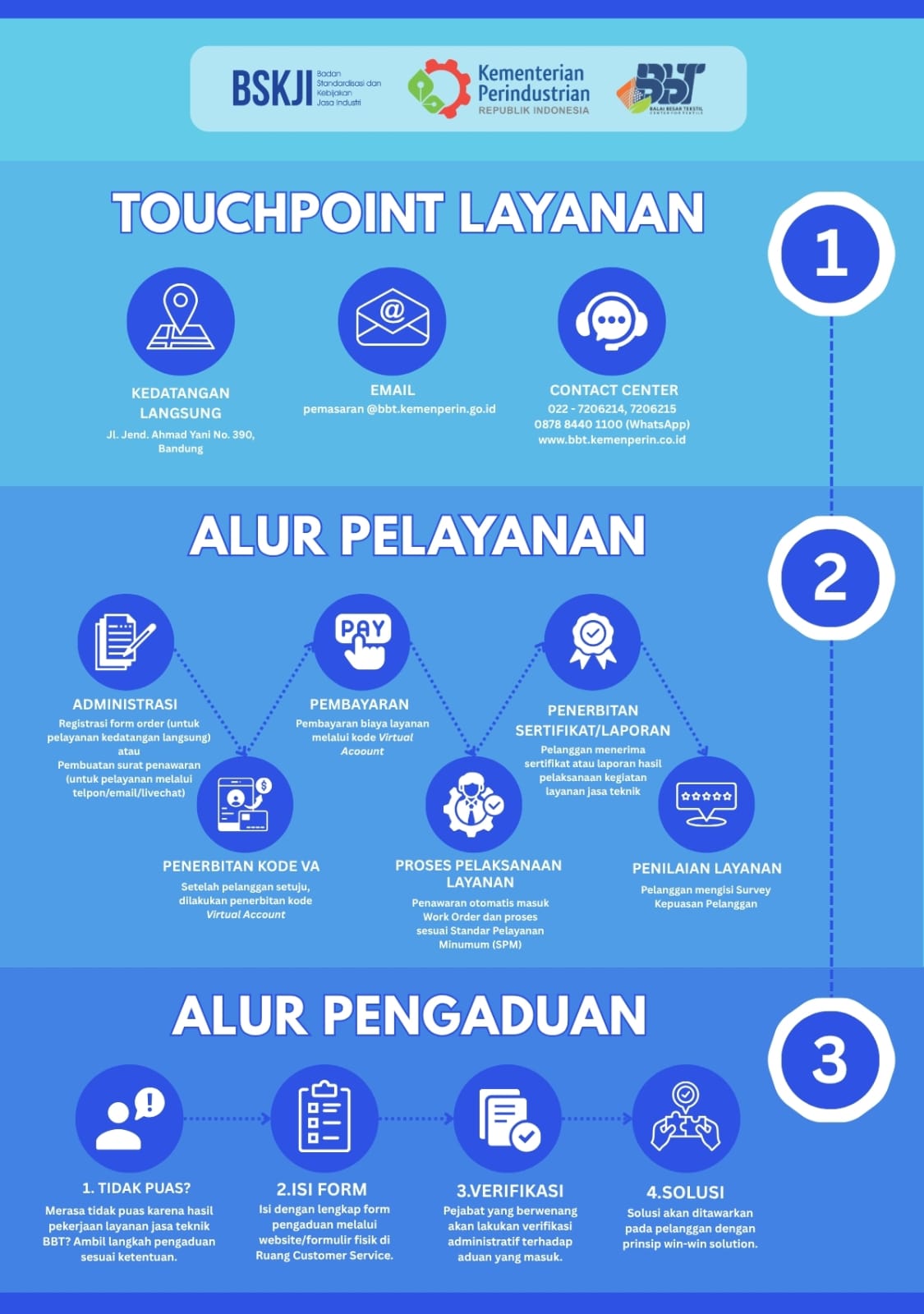
Information and service administration channels:
The masks that can be tested are surgical masks and respirator masks (masks with a particle-filtering function, similar to N95).
The reference standards are SNI EN 14683:2019+AC:2019 (medical masks) and SNI EN 149:2001+A1:2009 (respiratory masks).
Surgical mask test parameters:
Respirator mask test parameters:
Testing fees:
| Test Parameter | Fee |
|---|---|
| Bacterial Filtration Efficiency (BFE) | Rp 2,400,000.00 |
| Differential Pressure (DP) | Rp 600,000.00 |
| Splash Resistance Pressure / Blood Penetration | Rp 1,200,000.00 |
| Microbial Cleanliness (MC) | Rp 650,000.00 |
| Particulate Filtration Efficiency (PFE) | Rp 2,250,000.00 |
| Test Parameter | Number of Samples |
|---|---|
| Bacterial Filtration Efficiency (BFE) | 10 pieces |
| Differential Pressure (DP) | 8 pieces |
| Splash Resistance Pressure / Blood Penetration | 40 pieces |
| Microbial Cleanliness (MC) | 10 pieces |
| Particulate Filtration Efficiency (PFE) | 10 pieces |
No, because our PFE test equipment uses the SNI EN 149:2001+A1:2009 reference standard. PFE testing of surgical masks refers to the SNI 8488:2018 reference standard.
The reference quality standard is SNI 8913:2020 Textiles – Fabrics for surgical gowns, surgical drapes and medical coveralls.
The minimum standard referred to by the COVID-19 Task Force is ANSI/AMMI PB-70:2012.
It covers surgical gowns, surgical drapes and hazmat suits (medical coveralls), both reusable and disposable.
*) Applies to woven and knitted fabrics if they are coloured and will be washed with chlorinated water.
Under Tariff Government Regulation No. 54/2021, testing prices are as follows:
| Test Parameter | Fee |
|---|---|
| Water Impact | Rp 150,000.00 |
| Hydrostatic Pressure | Rp 150,000.00 |
| Flammability – Inclined Method | Rp 250,000.00 |
| Abrasion Resistance | Rp 650,000.00 |
| Tear Strength of Nonwovens – Tongue Method | Rp 230,000.00 |
| Tensile Strength of Woven Fabrics – Autograph | Rp 200,000.00 |
| Bursting Strength of Knitted Fabrics | Rp 125,000.00 |
| Colour fastness to chlorinated water | Rp 300,000.00 |
For the COVID-19 Task Force minimum standard (ANSI/AMMI PB70:2012), the test sample may be either fabric or a garment.
For SNI 8913:2020, the sample is fabric before sewing, because the title of the SNI refers to Textiles (fabric).
For ANSI/AMMI PB70:2012 (per test parameter):
For SNI 8913:2020 (full test parameters):
Yes, they can, because our Testing Laboratory is accredited by KAN.
To find out whether a customer's product meets the specified standard, refer to the quality tables in the ANSI/AMMI PB70:2012 or SNI 8913:2020 documents.
You can also check the Ministry of Health's online portal for the quality requirements that must be met for marketing authorization registration.
Registration of products in the goods group related to Security, Safety, Health and the Environment (K3L). Textiles and Textile Products (TPT) fall under goods containing hazardous chemicals and must be registered for K3L.
Minister of Trade Regulation No. 18 of 2019, updated by Minister of Trade Regulation No. 26 of 2021.
This Minister of Trade Regulation has been in force since 14 August 2019, but was in an outreach phase for one year after it took effect. From 14 August 2020, supervision of goods in circulation applies, along with administrative and criminal sanctions.
At a KAN-accredited Testing Laboratory, although the Ministry of Trade has not designated a specific laboratory. One of them is the Center for Textiles Testing Laboratory.
Textiles (dyed and/or printed woven/knitted fabrics made of cotton/man-made/blended fibers, with or without a plasticizer coating, with or without a functional coating); Carpets/floor coverings; Towels; Bed sheets; Pillowcases and bolster cases; Bedcovers; Handkerchiefs; Blankets; Mattresses.
To obtain an SNI product registration number, the product goes through a certification process at a Conformity Assessment Body (LPK). K3L, by contrast, is based on a self-declaration that includes product test results from a Testing Laboratory.
The regulation states that if a product is subject to Mandatory SNI, Mandatory SNI takes precedence and K3L registration is no longer needed.
The main parameters are (1) Extractable heavy metals (SNI 7334:2009); (2) Formaldehyde (SNI ISO 14184-1:2015); (3) Azo compounds (SNI ISO 24362-1:2015/SNI ISO 24362-3:2015). If the product is finished with plastic materials, the Total phthalates test parameter (SNI ISO 14389:2016) is added. If the product is finished with special-function substances, the test parameters for Flame-retardant chemicals (SNI ISO 17881-1:2017) and Water-repellent chemicals (SNI 8360:2017) are added.
Registration is indeed per brand. But testing is adjusted to the goods group, covering: fiber type (cotton/man-made fiber/blend of cotton and man-made fiber), fabric type (woven/knitted), and the finishing used (dyeing/printing/coating with certain substances). If 2 products use the same raw materials, only one of them needs to be tested. The Test Report can be used to register both.
The Center for Textiles serves the main K3L test parameters at the following fees under Tariff Government Regulation No. 54 of 2021:
| Test Parameter | Fee |
|---|---|
| Extractable heavy metals | Rp 800,000.00 / sample |
| Formaldehyde | Rp 350,000.00 / sample |
| Azo Compounds | Rp 1,000,000.00 / sample |
The service time standard of the Center for Textiles environmental laboratory is 10 (ten) working days, excluding any existing queue, from when the sample is received by the Public Service Unit and the service e-billing code has been paid.
All parameters must pass at the time of K3L registration, referring to the annex table of Minister of Trade Regulation No. 26 of 2021. If one parameter fails, the product finishing process must be improved and then retested.
This regulation applies to the brand holders of products in circulation. Under a contract manufacturing system, the company obliged to register is the one that distributes the product under its trademark.
This regulation exempts grey (greige) fabric and traditional batik made with hot-wax printing.
For finished products, K3L registration must still be carried out in the name of the company and the brand of the goods in circulation. However, product testing is no longer needed; simply reference the K3L registration number of the raw material used, provided there is no process other than sewing. If embroidery, screen printing, printing or additional coating finishes are applied, the company must have the product retested. Make sure the Textile category matches the type of finished product. Example: for bedcover products, the fabric used falls under the textile category of printed woven fabric coated with a special flame-retardant substance.
SNI 8914:2020 Textiles – Cloth masks.
It covers masks made of woven or knitted fabric with at least 2 layers of fabric. Baby masks are not included.
The quality of cloth masks is determined by their intended use.
These types are not a ranking of quality. Each type has different reference test parameters.