

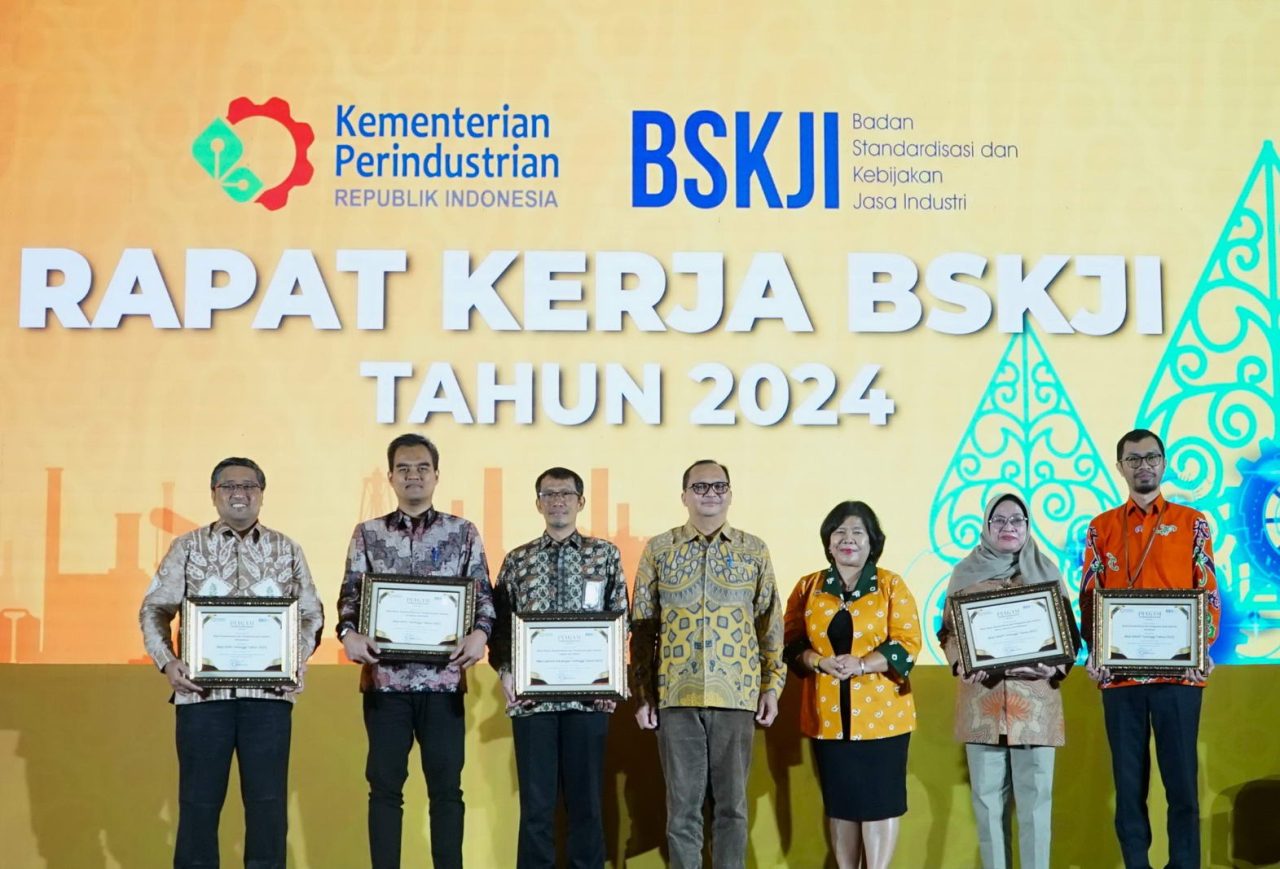
Standardization is an important instrument in developing a globally competitive national industry. Applying standards can protect consumers, businesses and the public.
“This protection covers health, safety, security and environmental sustainability. It also protects the domestic market from low-quality imports, creates fair and transparent competition, spurs innovation and increases business certainty,” Minister of Industry Agus Gumiwang Kartasasmita said in his online remarks at the 2024 Working Meeting of the Agency for Industrial Standardization and Services Policy (BSKJI) in Yogyakarta on Monday (22/1).
The Minister said another important activity in industrial development is industrial services. These provide support through services such as maintenance, engineering design, conformity assessment and other industrial services, all of which contribute to increasing industrial output.
“A variety of industrial services can help accelerate a country's economic diversification. To spur national industrial growth, the direction of standardization and industrial services policy is implemented through several strategies,” he explained.
One strategy is increasing the application of mandatory Indonesian National Standards (SNI) in industry, including their supervision. “BSKJI must play a role in increasing the number of mandatory industrial SNIs and supervising their implementation,” Agus said.
The Minister said there are currently 123 mandatory SNIs in force. “To accelerate the application of standards, Technical Specifications (ST) can be formulated to ensure product quality and safety at home more quickly,” he said.
The next strategy is expanding standardization that supports Industry 4.0 implementation. “Going forward, technology-related challenges will keep changing rapidly, and standardization is one of the keys for industry to compete,” he added.
Agus added that green industry development, including the circular economy concept, must also keep improving, especially in support of the Sustainable Development Goals by focusing on accelerating the number of industries applying Green Industry Standards.
“Industrial decarbonization actions also need to be monitored so that the 2030 Nationally Determined Contributions (NDC) target and the industrial sector's Net Zero Emission (NZE) target for 2050 can be achieved,” he stressed.
Through these strategies, Agus urged all work units within BSKJI to keep driving the transformation of Technical Implementation Units (UPT) into Public Service Agencies (BLU). “We are also pushing to establish UPTs in eastern Indonesia to spread and improve the equity of services across Indonesia, and finally, BSKJI's UPTs must broaden the types of services for industry in line with current issues,” he said.
On the same occasion, the Head of BSKJI, Andi Rizaldi, said the 2024 BSKJI Working Meeting, themed “Accelerating the Strengthening of Standardization and Industrial Services through an Integrated Ecosystem to Realize a Resilient Industry”, focused on strengthening the industrial standardization industry needs to increase its competitiveness.
“Companies that follow standards tend to be more competitive, have a better reputation and greater customer trust, and of course applying standards gives companies a basis for innovation,” he explained.
Industrial services are inseparable from manufacturing activities. BSKJI's role at the Ministry of Industry is therefore vital in developing national industry, because besides being a regulator, BSKJI also has UPTs directly involved in implementing the regulations set.
“To support this, BSKJI has national priority programs in 2024 covering industrial standardization including supervision, green industry, use of industrial technology and industrial services policy, and strengthening UPT facilities within BSKJI,” he said.
In 2024, national priority activities in green industry are a focus and receive relatively significant allocations. This relates to Kemenperin's efforts to meet greenhouse gas (GHG) emission reduction targets, including designating eight energy-intensive subsectors that are also the largest GHG emitters.
“These national priority programs include drafting decarbonization and carbon economic value policies for industry, drafting low-carbon development and GHG reduction policies, and facilitating green industry certification,” Andi said.
National priority programs in industrial standardization for 2024 include drafting SNI drafts, Technical Specifications (ST) and/or Procedural Guidelines (PTC), drafting technical regulations to enforce standards, supervising SNI products, supervising Conformity Assessment Bodies (LPK) and strengthening industrial standardization cooperation. “To support UPT services, there are national priority programs for procuring laboratory equipment and renovating public service and laboratory buildings,” he said.
Source: Press Release of the Ministry of Industry of the Republic of Indonesia