

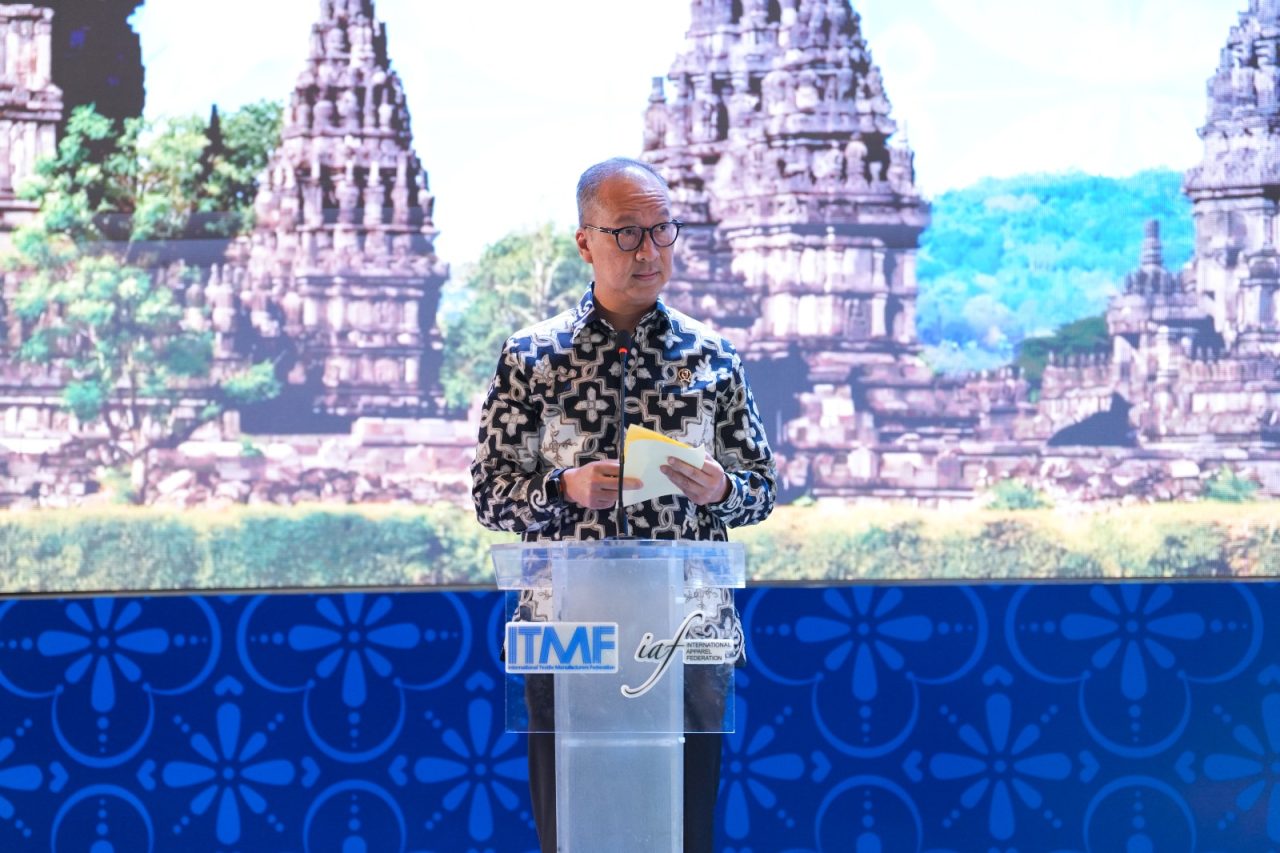
Minister of Industry Agus Gumiwang Kartasasmita affirmed that Indonesia is ready to be a strategic partner as well as a global center of innovation and growth for the textile and textile product (TPT) industry. He said this in his speech at the ITMF (International Textile Manufacturers Federation) & IAF (International Apparel Federation) World Fashion Convention Annual Conference 2025.
“Indonesia is here not merely as a host, but as a strategic partner ready to play an active role in advancing the global textile industry. Indonesia's TPT sector has proven resilient, adaptive and competitive amid global uncertainty,” Minister Agus said in Yogyakarta on Friday (24/10).
On that occasion, the Minister of Industry also said the textile and textile product (TPT) industry continues to grow and is no longer a ‘sunset industry’. During the first year of the government of President Prabowo Subianto and Vice President Gibran Rakabuming Raka, from Q4 2024 to Q2 2025, the TPT industry grew by 5.39% and contributed 0.98% to Indonesia's national GDP.
“The Ministry of Industry is working to maintain this growth momentum by applying several key policies designed to strengthen competitiveness, grow investment and accelerate the transformation of the TPT industry,” he said.
First, Kemenperin seeks to provide ease and certainty in investing. Through Government Regulation No. 28 of 2025 on Risk-Based Business Licensing, the government has simplified business processes via the updated Online Single Submission (OSS) system to ensure faster, more transparent and more predictable procedures.
Second, Kemenperin runs the Machinery and Equipment Restructuring program to support the replacement of old machines with modern, energy-efficient equipment for the TPT industry. Since it began, the program has increased production capacity by 21.75%, energy efficiency by 11.86%, employment by 3.96% and sales volume by 6.65%.
Third, distributing the Labor-Intensive Industry Credit scheme. The scheme provides access to financing facilities of up to IDR 20 trillion in 2025, helping around 2,000 to 10,000 industrial companies, including textile and apparel producers, to expand and maintain employment levels.
Fourth, providing the Masterlist Facility for importing capital goods. The Minister explained that this policy can guarantee import duty exemptions for capital goods used to improve production efficiency and continuity.
Finally, the government provides fiscal incentives, including tax holidays, tax allowances, investment allowances and super deduction tax for companies that invest in research and development and vocational education.
These policies are government initiatives to reaffirm our commitment to supporting a textile industry ecosystem that is resilient, sustainable and globally competitive. “In these conditions, the TPT industry remains a strategic pillar of the industrial manufacturing base and plays an important role in maintaining inclusive growth, creating jobs and supporting the livelihoods of this country,” he explained.
The competitiveness of Indonesian TPT products can be seen in one of the most important export destination markets, the United States. Indonesian TPT products under HS 61 (knitted apparel and accessories) rank as Indonesia's second-largest trade surplus commodity, worth USD 1.86 billion, even exceeding footwear (HS 64), which reached only USD 1.85 billion.
According to the Minister of Industry, this confirms the sustainable competitiveness and resilience of Indonesia's TPT sector, which gives Indonesia a favorable position to take advantage of the recent reciprocal tariff arrangement with the United States.
Agus said that, globally, Indonesia is among the five most efficient textile producers. In the yarn spinning subsector, for example, Indonesia's production costs are USD 2.71 per kilogram, more efficient than India, China and Turkey, and on a par with Vietnam and Bangladesh. In the weaving subsector, Indonesia recorded costs of USD 8.84 per meter, one of the lowest in the world. In fabric finishing, production costs are USD 1.16 per meter, lower than most regional competitors.
“These figures are proof of Indonesia's global competitiveness and can be a strong foundation for future growth,” he said.
In an era of massive transformation, climate challenges, geopolitical shifts, digital disruption and supply chain restructuring, Indonesia believes that opportunities remain. “With abundant resources, adaptive industrial policies and skilled human resources, Indonesia reaffirms its readiness to be a trusted partner of the global textile industry in building sustainable growth for decades to come. Indonesia is ready to be a global hub for textile innovation, manufacturing and growth,” the Minister of Industry stressed.
The Chair of API, Jemmy Kartiwa, said the conference is an important moment for stakeholders in the textile and fashion industry worldwide to collaborate and showcase innovation and technology amid global uncertainty and synergy with government policies.
Jemmy therefore expressed appreciation to the government, which continues to strive to produce regulations aimed at the interests of labor-intensive industries and the domestic textile and textile product industry. “With strong protection from government policy, the position of Indonesian industry will become stronger in facing global competition full of challenges from changes in supply chains and world trade,” he said.
Source: Press Release of the Ministry of Industry of the Republic of Indonesia