

The chemical, pharmaceutical and textile industries (IKFT) recorded positive cumulative growth of 4.2 percent through the third quarter of 2024. With this strong performance, the IKFT sector also made a significant contribution to the performance of manufacturing and the national economy.
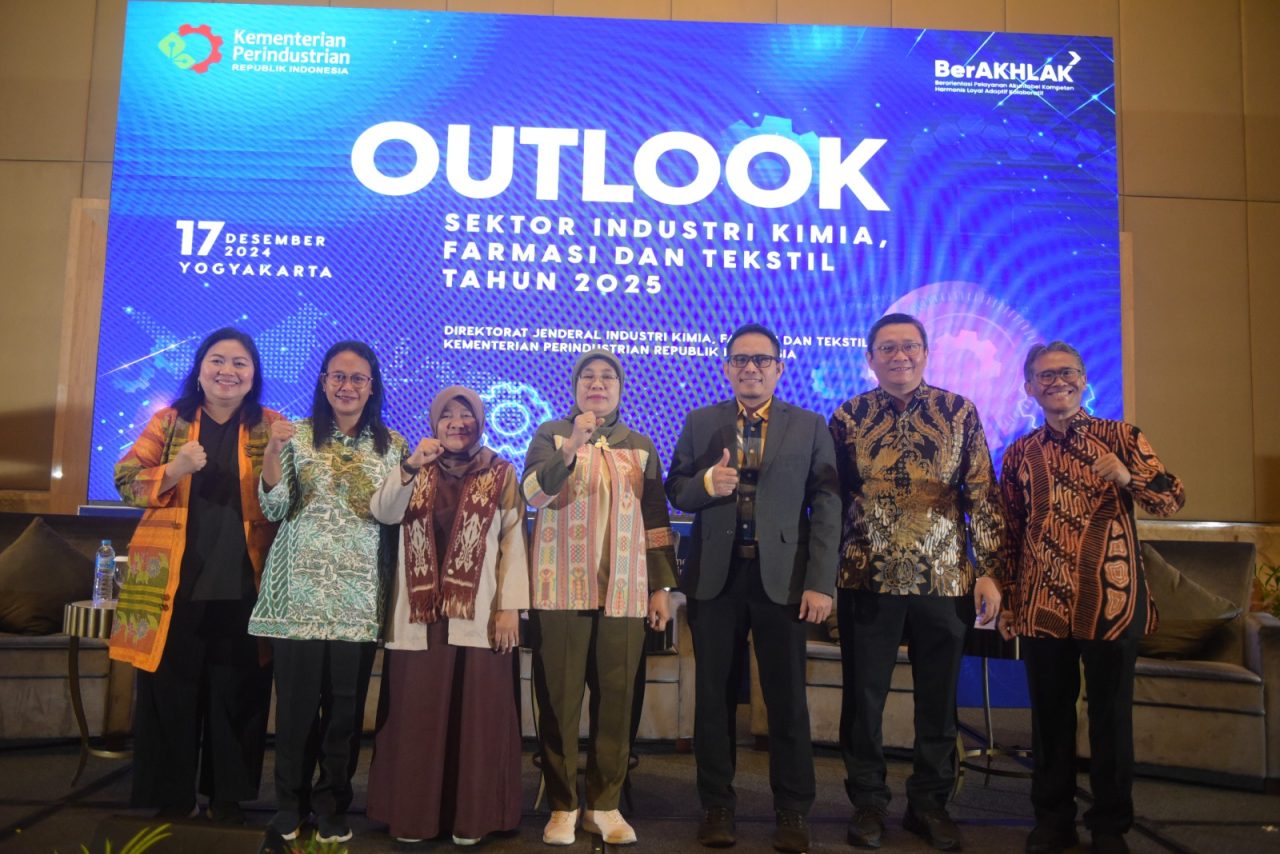
“The IKFT sector still makes a large contribution to the performance of the non-oil and gas processing industry and national Gross Domestic Product (GDP), at 22.46 percent and 3.87 percent respectively in Q3-2024,” the Acting Director General of IKFT at the Ministry of Industry (Kemenperin), Reni Yanita, said at the “2025 Outlook for the Chemical, Pharmaceutical and Textile Industry Sector” event in Yogyakarta on Tuesday (17/12).
The IKFT sector's positive achievement was supported by several subsectors showing significant growth. According to Statistics Indonesia (BPS) data, year-on-year (YoY), the leather, leather goods and footwear industry recorded the highest growth at 10.15 percent in Q3-2024.
That 10.15 percent figure is a significant jump compared with growth in previous quarters, namely 5.90 percent in Q1-2024 and 1.93 percent in Q2-2024. It is also higher than the same period last year (Q3-2023), which saw a contraction of 2.96 percent.
Another subsector that recorded positive growth was textiles and apparel, which grew 7.43 percent in Q3-2024 (YoY), up from Q1-2024 (2.64 percent), Q2-2024 (-0.03 percent) and Q3-2023 (-2.96 percent).
Next, the rubber, rubber goods and plastics industry also recorded positive growth of 3.46 percent in Q3-2024, exceeding Q1-2024 (-5.24 percent), Q2-2024 (2.13 percent) and Q3-2023 (-4.34 percent). Meanwhile, the chemical, pharmaceutical and traditional medicine industry also grew positively by 3.08 percent in Q3-2024.
“However, although the IKFT sector's performance is positive at the macro level, there are still several challenges that need attention, such as unstable global economic and political conditions, the onslaught of imported finished goods, and regulations that do not yet fully support domestic industry,” Reni said.
Kemenperin is therefore focusing on driving manufacturing, including the IKFT sector, so that it remains the backbone of the national economy. “Manufacturing is still the sector that can accelerate economic growth and serve as the prime mover of the national economy,” she said.
In the IKFT sector, Kemenperin remains committed to consistently carrying out strategic measures, including controlling imports of finished goods, increasing exports, maintaining the availability of raw materials and energy for domestic industry, and increasing domestic industrial utilization.
In addition, pro-industry policies are needed to support achieving the targets in Phase I (2025–2029) of the National Long-Term Development Plan (RPJPN). “One proposed step, for example, concerns expanding the implementation of the certain natural gas price (HGBT) program, which plays an important role in strengthening domestic industry,” Reni said.
Other flagship programs for developing the IKFT sector include machinery and equipment restructuring, facilitating petrochemical industry development, coal gasification, industrial downstreaming, implementing sustainability, decarbonization, the circular economy, facilitating Industry 4.0 implementation, and the program to increase the use of domestic products (P3DN).
IKFT sector targets
On the same occasion, the Acting Director General of IKFT said the government has set an economic growth target of 8 percent over the next five years. To achieve this, the industrial sector will continue to be one of the main pillars of the national economy.
“The 2025–2045 RPJPN sets out the Golden Indonesia 2045 Vision: Indonesia as a united, sovereign, advanced and sustainable Unitary State of the Republic of Indonesia. One of the main goals of the Golden Indonesia 2045 Vision is to join the world's five largest economies, driven mainly by raising manufacturing's contribution to GDP to 28.0 percent,” she explained.
To achieve this goal, there are four stages of economic transformation from 2025 to 2045. The first stage (2025–2029) focuses on downstreaming natural resources, strengthening research and innovation, and increasing labor productivity. “The processing industry is targeted to account for 21.9 percent of the national economy,” she added.
With this target, the IKFT sector is being pushed to grow by 6.59 percent in 2025, 7.97 percent in 2027 and 7.59 percent in 2029. Subsectors expected to drive IKFT growth include chemicals, pharmaceuticals and traditional medicine, with a growth target of 7.98–9.33 percent, and non-metallic mineral products, with a growth target of 8.36–8.74 percent.
“The IKFT sector's contribution to national GDP is also targeted to rise from 3.62 percent in 2025 to 3.86 percent in 2029. Subsectors expected to drive this contribution include chemicals, pharmaceuticals and traditional medicine, with a target contribution of 1.44–1.62 percent, and textiles and apparel, with a contribution of 1.07–1.09 percent,” she said.
Reni is optimistic that the IKFT sector's performance will continue to soar if strategic programs and activities are supported by a conducive business climate through regulations that favor domestic industry. Efforts by the Directorate General of IKFT include increasing investment through policies facilitating petrochemical industry investment in Teluk Bintuni, Tanjung Enim and East Kutai.
In addition, investment promotion will be facilitated, especially in textiles, footwear and downstream chemicals, along with facilitating industrial downstreaming and supervising business licensing. Fiscal and non-fiscal facilities are also needed, such as the Certain Natural Gas Price (HGBT) policy, easier incentives and import controls.
To improve and use technology and innovation, Ditjen IKFT will run a machinery and equipment restructuring program for the textile, leather and footwear industries; assist Industry 4.0 implementation in chemicals, pharmaceuticals and textiles; accelerate decarbonization policies in these sectors; and implement sustainability and the circular economy for used clothing, footwear, plastics, used lubricants, end-of-life tyres (ELT) and downstream rubber products.
Ditjen IKFT will also improve supply chains through policies strengthening upstream and intermediate industries in the TPT sector, harmonizing and aligning tariff and non-tariff policies across upstream, intermediate and downstream, and drafting policies to improve the efficiency of material flows.
“We will also keep increasing cooperation and promotion in international negotiating forums, as well as promotion and access to overseas markets. And finally, to maintain the sustainability of domestic industry, we are also focusing on planning and developing industrial standardization and technical regulations,” she concluded.
Source: Press Release of the Ministry of Industry of the Republic of Indonesia