

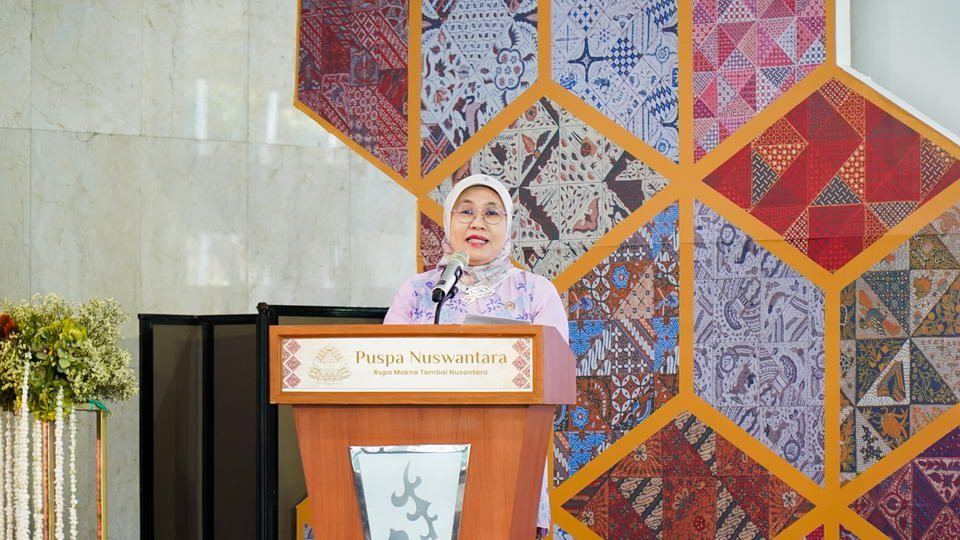
The Ministry of Industry supports the efforts of the Indonesian Batik Craftsmen and Entrepreneurs Association (APPBI) and the Indonesian Batik Foundation in safeguarding and preserving one of the world-recognized intangible cultural heritages, namely batik made by Indonesian craftsmen. The Ministry of Industry continues to promote the importance of consumer understanding in distinguishing authentic batik amid the flood of batik-patterned textile products on the market. One way is through its support for the Indonesian Batik Art Performance Puspa Nuswantara 2026, organized by APPBI on 8–12 July 2026 at the Jakarta International Convention Center, Senayan, Jakarta.
The goals of the Puspa Nuswantara Batik Art Performance are in line with the task of the Ministry of Industry, through the Directorate General of Small, Medium and Miscellaneous Industries, to protect the authenticity of batik while encouraging batik SMI players to move up a class. Minister of Industry Agus Gumiwang Kartasasmita said young people's interest in wastra-based fashion keeps growing, so batik is no longer seen as stiff and formal attire, but as part of everyday lifestyle.
“The batik industry continues to show a positive trend, both in domestic and international markets. Exports are rising, and young people are increasingly proud to wear batik, which reflects the nation's cultural identity,” Minister of Industry Agus Gumiwang Kartasasmita said in Jakarta on Wednesday (8/7).
Statistics Indonesia data show that batik product exports in 2025 reached USD 30.62 million, up 13.03 percent from USD 26.63 million the previous year. Despite this growth, the batik industry also faces the challenge of increasingly widespread batik-patterned printed fabrics on the market.
“These products are generally sold at much lower prices and can be mass-produced in a short time, so they have the potential to displace authentic batik, both in terms of the market and public appreciation of the cultural value it embodies,” Agus said.
In fact, Agus continued, consumers can easily tell authentic batik from batik-patterned fabric or textiles. Authentic batik, whether hand-drawn (tulis) or stamped (cap), is made through a color-resist process using malam (wax), so the resulting pattern penetrates to the back of the fabric and the color may differ slightly from one side to the other.
“Authentic batik generally has the distinctive scent of wax, pattern lines that are not always precise because they are made by hand, and a price that reflects the time and skill involved,” Agus said.
Agus considers that understanding the difference between authentic batik made by craftsmen and batik-patterned fabric is important to keep promoting to the public, so that consumers can make the right choice when buying authentic batik and batik craftsmen receive the appreciation they deserve. Printed fabric has a pattern printed on only one side of the fabric surface, more even and uniform colors, very neat pattern lines because it is machine-printed, and is generally sold at much more affordable prices.
The Director General of Small, Medium and Miscellaneous Industries, Reni Yanita, added that Ditjen IKMA routinely runs various development and assistance programs for batik SMIs to protect the authenticity of batik and strengthen the batik SMI ecosystem in domestic and overseas markets. These include Batikmark facilitation, an assistance program helping batik SMIs meet the requirements for Batikmark certification as the official mark of batik made in Indonesia.
“With Batikmark, the products of assisted SMIs have clear proof of authenticity, so consumers can recognize their authenticity and craftsmen receive the protection and added value they deserve,” Reni explained.
In addition, Ditjen IKMA holds technical guidance on improving the production efficiency of batik SMIs, which aims to increase the productivity and efficiency of batik craftsmen's production processes, from design and dyeing to finishing, so that they can produce higher-quality products at more competitive production costs.
There is also a program to strengthen Geographical Indications, as a legal protection instrument for batik with distinctive characteristics and qualities closely tied to its region of origin. Through Geographical Indications, Reni said, regional batiks can gain stronger recognition and protection at national and international levels.
Besides these three programs, Ditjen IKMA also continues to offer various other support programs for batik SMIs to move up a class, including facilitation of self-declared Domestic Component Level (TKDN) certification, which provides ease and certainty for SMI products in government procurement of goods/services.
Ditjen IKMA also regularly opens programs to restructure production machinery and equipment to increase production capacity and quality, training to improve the competence of SMI human resources, and facilitation of market access and financing so that batik SMI products can compete more strongly in domestic and overseas markets.
The Director of Chemical, Clothing and Craft SMIs, Budi Setiawan, said Ditjen IKMA of Kemenperin continually collaborates with various parties in batik SMI assistance programs, including opening market access through various exhibitions held by craftsmen's associations.
Budi hopes the Indonesian Batik Art Performance Puspa Nuswantara 2026, held through cooperation between APPBI, the Indonesian Batik Foundation and PT Satu Tujuan Event, will expand the market for batik products and bring consumers closer to the richness of the archipelago's wastra. “We hope this event will further strengthen public love for batik while driving the progress of the national batik industry,” Budi said.
Source: Press Release of the Ministry of Industry of the Republic of Indonesia