

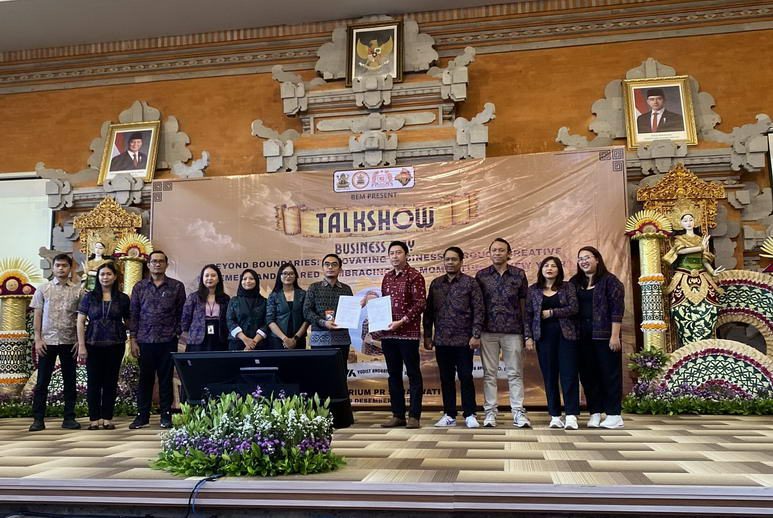
The Ministry of Industry continues to strengthen the transformation of small and medium industries (SMIs) so that they become more competitive, sustainable and based on local cultural values. One such effort is a collaboration between the Fashion and Craft Industry Empowerment Center (BPIFK) and Mahasaraswati University (UNMAS) Denpasar in developing the Sustainability and Culture Business Model Canvas (SC-BMC).
Minister of Industry Agus Gumiwang Kartasasmita said the transformation of SMI business models is a strategic agenda in supporting the New National Industrialization Strategy (SBIN), which places sustainability, innovation and the strengthening of local identity as the foundation of national industrial development.
“Fashion and craft SMIs have great potential to become drivers of a sustainable, culture-based economy. Through a business model approach that integrates economic, social, environmental and cultural aspects, SMIs can not only increase their competitiveness, but also create sustainable added value with an Indonesian character,” the Minister of Industry said in a statement in Jakarta on Wednesday (14/1).
As a concrete form of this collaboration, BPIFK and UNMAS Denpasar have signed a Memorandum of Understanding (MoU) and carried out joint research on applying SC-BMC. This model is an extension of the classic Business Model Canvas (BMC) that integrates the principles of sustainability and culture into business model design.
“In this way, SC-BMC addresses not only profitability, but also positive impacts on people, the environment and the preservation of local values,” said the Director General of Small, Medium and Miscellaneous Industries (IKMA), Reni Yanita.
According to Reni, a pilot test of applying the local-culture-based SC-BMC was carried out on 15 SMIs in Bali under real business conditions. The results show that the model helps SMI players understand their business potential and challenges more comprehensively, while encouraging business practices that balance economic, social, environmental and cultural aspects.
“Collaboration between government, universities and industry players is therefore key to accelerating national industrial transformation,” she explained. With the support of human resources, applied research and the right policies, fashion and craft SMIs are believed to be able to move up a class and penetrate national and global markets.
Furthermore, the research showed that SC-BMC is able to integrate economic, social, cultural and environmental aspects in a unified way. The model not only functions as a business planning tool, but also as an approach for transforming SMIs into competitive, sustainable businesses with social and cultural legitimacy.
The business model developed consists of 15 integrated blocks combining economic, social, environmental and cultural dimensions. The results of this joint research between BPIFK and UNMAS Denpasar are one of the enabling factors that can support the success of SBIN, and are expected to be widely practiced by SMIs as a business development tool.
“The results of this research are an important basis for formulating policies to strengthen fashion and craft SMIs. The SC-BMC business model proves that sustainability and culture can go hand in hand with profitability. This is an important foundation for strengthening green and globally competitive SMIs,” Reni added.
From a market perspective, SC-BMC is considered effective in responding to national and global trends such as the conscious consumer, sustainability, digitalization and the revival of products based on local culture. Differentiation based on cultural identity provides added value that is hard for mass manufacturing products to imitate, especially for premium market segments, cultural tourism and value-based exports.
Social and cultural aspects also showed significant impacts through the empowerment of local human resources, the preservation of traditional knowledge and the strengthening of community values. On the environmental side, applying the principles of circularity, using eco-materials, reuse practices and energy efficiency have been shown to reduce resource use and emissions without reducing product value.
“Collaboration with universities is key to driving industrial transformation. This cooperation does not stop at signing the MoU, but is a shared commitment to provide assistance, innovation and practical business models for fashion and craft SMIs in Indonesia,” said the Head of BPIFK, Dickie Sulistya.
Going forward, the cooperation between BPIFK and UNMAS Denpasar is expected to strengthen Indonesia's position in national and international fashion and craft markets through business approaches that are sustainable, rooted in local culture and inclusive of SMI players.
Source: Press Release of the Ministry of Industry of the Republic of Indonesia