

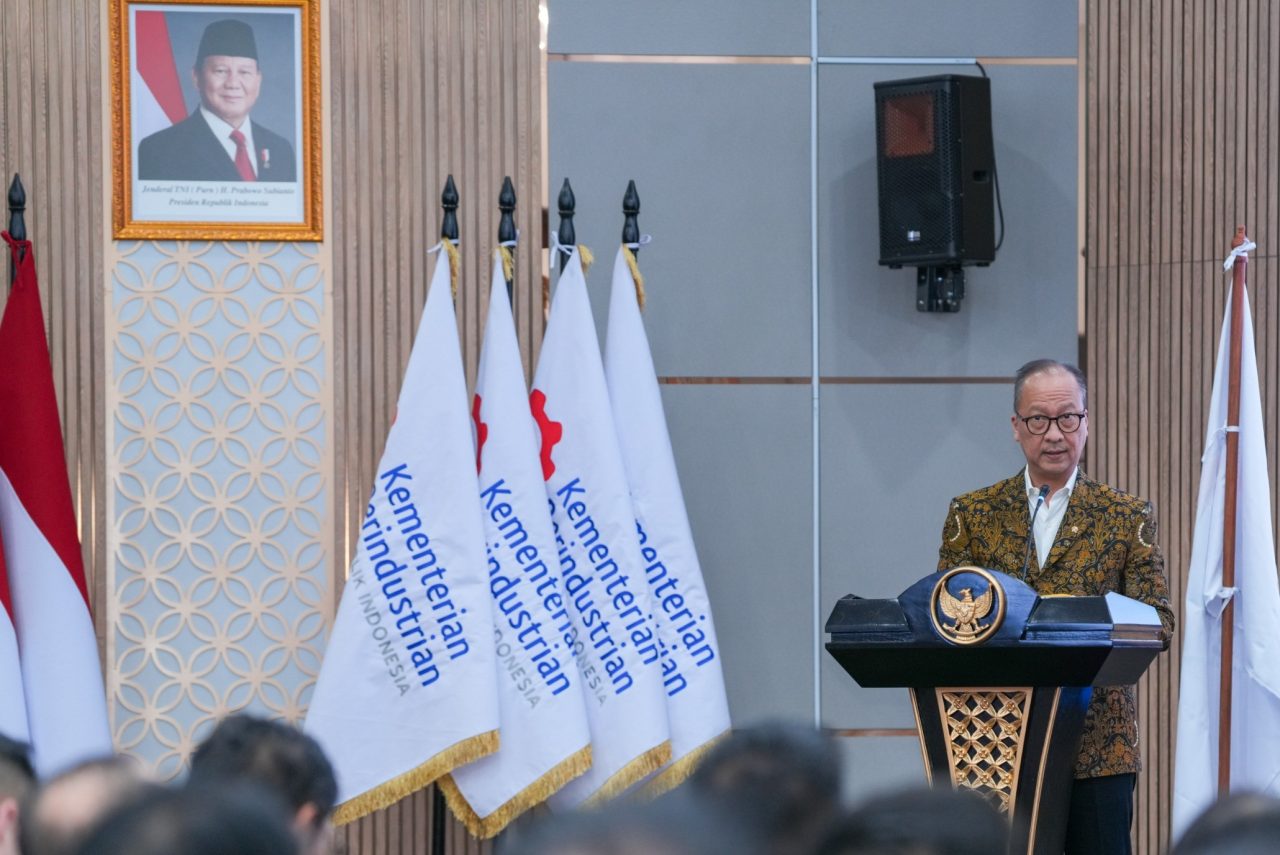
The Ministry of Industry has reaffirmed its commitment to accelerating national industrialization as one of the main instruments for achieving quality economic growth, creating jobs, strengthening economic self-reliance and improving public welfare. This step is in line with the direction of President Prabowo Subianto in the President's Speech at the 2026 Annual Session of the MPR and the Joint Session of the DPR and DPD, on Thursday (14/8).
Minister of Industry Agus Gumiwang Kartasasmita said the President's message on the importance of economic growth and investment that brings real benefits to the public further reinforces the position of the manufacturing sector as the backbone of the national economy.
“The President emphasized that growth and investment are not the end goal, but instruments for improving people's welfare. Every investment must be able to create jobs and every policy must improve people's lives. For the Ministry of Industry, this direction strengthens our determination to pursue industrialization that is inclusive, competitive and that creates as much added value as possible at home,” the Minister of Industry said in Jakarta on Friday (14/8).
In his speech, the President said that amid geopolitical conflicts, trade wars, supply chain disruptions and global economic pressures, Indonesia must become increasingly able to stand on its own feet. The President also said that realized investment throughout 2025 reached IDR 1,931 trillion and created more than 2.7 million jobs, while in Semester I-2026 realized investment reached IDR 1,010 trillion and created more than 1.4 million jobs.
According to the Minister of Industry, the message on self-reliance is highly relevant to the national industrial development agenda, because a strong industry will reduce dependence on imported products, deepen the industrial structure, increase mastery of technology, strengthen domestic supply chains and produce high value-added products.
“In a global situation full of uncertainty, we must not depend too much on other countries to meet our strategic national needs. We must therefore build an industrial structure that is ever deeper and integrated from upstream to downstream. Indonesia must be able to process the resources we have into high value-added industrial products at home,” Agus said.
The Minister of Industry considers that this policy direction has shown positive results. According to Statistics Indonesia (BPS) data, in Q2-2026 the non-oil and gas manufacturing industry (IPNM) grew by 5.32 percent annually (year-on-year/y-o-y). This was higher than national economic growth in the same period of 5.29 percent.
Besides growing faster than the national economy, the manufacturing sector contributed 18.50 percent of gross domestic product (GDP), remaining the largest contributor to Indonesia's economic structure. Manufacturing was also the largest source of economic growth, contributing 0.90 percent.
“This achievement shows that the President's policies, which strongly favor the industrial sector, have had a concrete impact. Manufacturing is not only growing, but its growth has outpaced national economic growth. This is very important capital for continuing to expand the role of industry as the engine of the economy,” the Minister of Industry said.
SBIN Strengthens the Direction of Industrialization
Agus explained that the Ministry of Industry translates the President's direction through the implementation of the National Industrialization Grand Strategy (SBIN). The strategy aims to strengthen the national industrial structure, accelerate downstreaming and value addition, increase productivity and competitiveness, expand markets and create quality jobs.
According to the Minister of Industry, the industrialization pursued by the government is not only oriented toward higher growth figures, but also ensures that more economic value added is created and enjoyed at home.
“Industrialization must produce a broad multiplier effect . When an industry grows, it is not just the factory that develops. Workers are absorbed, suppliers of raw materials and components grow, SMIs enter the supply chain, logistics activity increases, technology develops, and exports become stronger,” he explained.
The current positive performance of national industry is also reflected in several manufacturing activity indicators. The Manufacturing Industry Business Conditions and Prospects Index (IKBM) stands at 52.31, indicating expansion. Meanwhile, Indonesia's Manufacturing Purchasing Managers’ Index (PMI) in July 2026 stood at 50.2, and the Industry Confidence Index (IKI) for July 2026 reached 53.10. All three indicators show that national industrial activity remains in the expansionary zone.
“This shows that industry players remain optimistic about business prospects. The government must maintain this momentum through policies that provide business certainty, strengthen the domestic market, increase investment and create an increasingly competitive industrial climate,” Agus said.
IPNM growth in Q2-2026 was also supported by several strategic subsectors. The food and beverage industry grew by 6.51 percent, in line with rising domestic and export demand.
Meanwhile, the metal goods, computer, electronic, optical and electrical equipment industry recorded growth of 8.04 percent, supported by rising global demand for electronic components, batteries and various electrical equipment. The chemical, pharmaceutical and traditional medicine industry grew by 4.99 percent, partly due to increased domestic demand for chemicals and their derivative products.
Downstreaming Must Create Jobs
The Minister of Industry also welcomed the President's direction to keep accelerating the downstreaming of natural resources. In his speech, the President said that the profits of state-owned enterprises (BUMN) are used to accelerate downstreaming, including through the groundbreaking of 13 downstreaming projects on 6 February 2026 and another 13 projects on 29 April 2026.
The projects include processing coal into dimethyl ether (DME), copper and gold downstreaming, industrial salt processing, and processing alumina into aluminum. The President emphasized that these projects generate tens of thousands of new jobs.
According to Agus, downstreaming must continue to be expanded so that it does not stop at processing commodities into intermediate products. Downstreaming needs to be directed all the way to high value-added final products and to strengthening the national industrial ecosystem.
“We must take downstreaming ever deeper. The longer the value chain built in Indonesia, the greater the value added that stays in the country and the more jobs we can create. This is the essence of the industrialization we are building,” the Minister of Industry stressed.
This is also in line with the President's assertion that every rupiah of investment must be able to create jobs. The Ministry of Industry notes that, based on May 2026 data, the manufacturing sector accounted for 13.53 percent of national employment, out of a total working population of 148.19 million people.
Agus stressed that job creation is one of the important considerations in developing the industrial sector. Indonesia therefore needs investment that brings not only capital but also technology, strengthens domestic supply chains, uses domestic products, develops human resources and opens up employment opportunities.
“We want incoming investment to have the widest possible economic impact. Investment must be part of building the national industrial ecosystem, not stand as an enclave unconnected to domestic industry,” he said.
Strengthening the Domestic Market
The Minister of Industry added that economic self-reliance, as emphasized by the President, also requires a stronger domestic market. With its large population, Indonesia has a market with great potential that national industry must make the most of.
Data show that household consumption is still growing, reflected among other things in the value of consumer goods imports, which rose by 27.15 percent annually. According to Agus, this shows on the one hand that domestic demand remains strong, but on the other hand signals that national industry's ability to meet domestic market needs still needs to be strengthened.
“We have a very large domestic market. We must not let the rise in household consumption be enjoyed mostly by imported products. We must use the momentum of growing demand to increase national industrial production,” he said.
The government therefore needs to further strengthen policies protecting domestic industry, including industries supplying raw materials and components. Strengthening the industrial structure is needed so that more of the domestic market's needs can be met by national production while reducing dependence on imports.
The Minister of Industry also noted that in Q2-2026, net exports still made a negative contribution of 0.78 percent to economic growth. This is an important reminder to keep increasing the competitiveness of national industrial products, expanding export markets and strengthening import substitution.
“That is why the agenda for strengthening domestic industry must move on two fronts at once. First, increasing national industry's ability to meet the domestic market. Second, improving competitiveness so that Indonesian manufactured products can penetrate global markets more strongly,” Agus explained.
Expanding Global Supply Chains
The Minister of Industry also highlighted the President's statement on the importance of economic diplomacy that can open markets for Indonesian products, bring in investment and technology, and create jobs.
The President said that 25 trade agreements have now been implemented, including five new trade agreements that came into effect in the past year. In addition, two agreements are in the ratification process, 13 agreements are under negotiation, and two others are awaiting a signing date.
According to Agus, this expanded market access must be optimally used by the national manufacturing sector. “We must use trade agreements to increase exports of value-added manufactured products, not simply to increase trade in raw commodities. National industry must enter global supply chains ever more deeply,” he said.
The Ministry of Industry also considers important the President's message on efforts to acquire technology, management and international market access so that Indonesia can become increasingly integrated into world supply chains.
According to the Minister of Industry, technological transformation is one of the prerequisites for increasing the productivity and competitiveness of national industry. Investment that brings technology transfer, human resource development, research and innovation, and the involvement of domestic industry will therefore become increasingly strategic.
“Our target is not merely to be a market. Indonesia must become a production base, an innovation base and an important part of the world's supply chains. To achieve this, we need industry that is productive, efficient, innovative and green, supported by competent industrial human resources,” he said.
The Minister of Industry stressed that the Ministry of Industry will continue to safeguard the President's direction through pro-industry policies capable of strengthening national manufacturing. Implementation of SBIN will continue to be accelerated, prioritizing the strengthening of the industrial structure, downstreaming, import substitution, technological transformation, green industry development, improved human resource quality, and expansion of domestic and export markets.
“The President's message is very clear: Indonesia must become increasingly able to stand on its own feet. For us, one of the main foundations for achieving this is a strong and sovereign national industry. That is why we must keep maintaining and increasing the momentum of manufacturing growth, which is now outpacing national economic growth,” Agus stressed.
“Industrialization is not solely about building factories. Industrialization is about creating added value, building self-reliance, mastering technology, opening up jobs and ensuring that Indonesia's wealth brings the greatest possible benefit to the Indonesian people,” the Minister of Industry concluded.
Source: Press Release of the Ministry of Industry of the Republic of Indonesia