

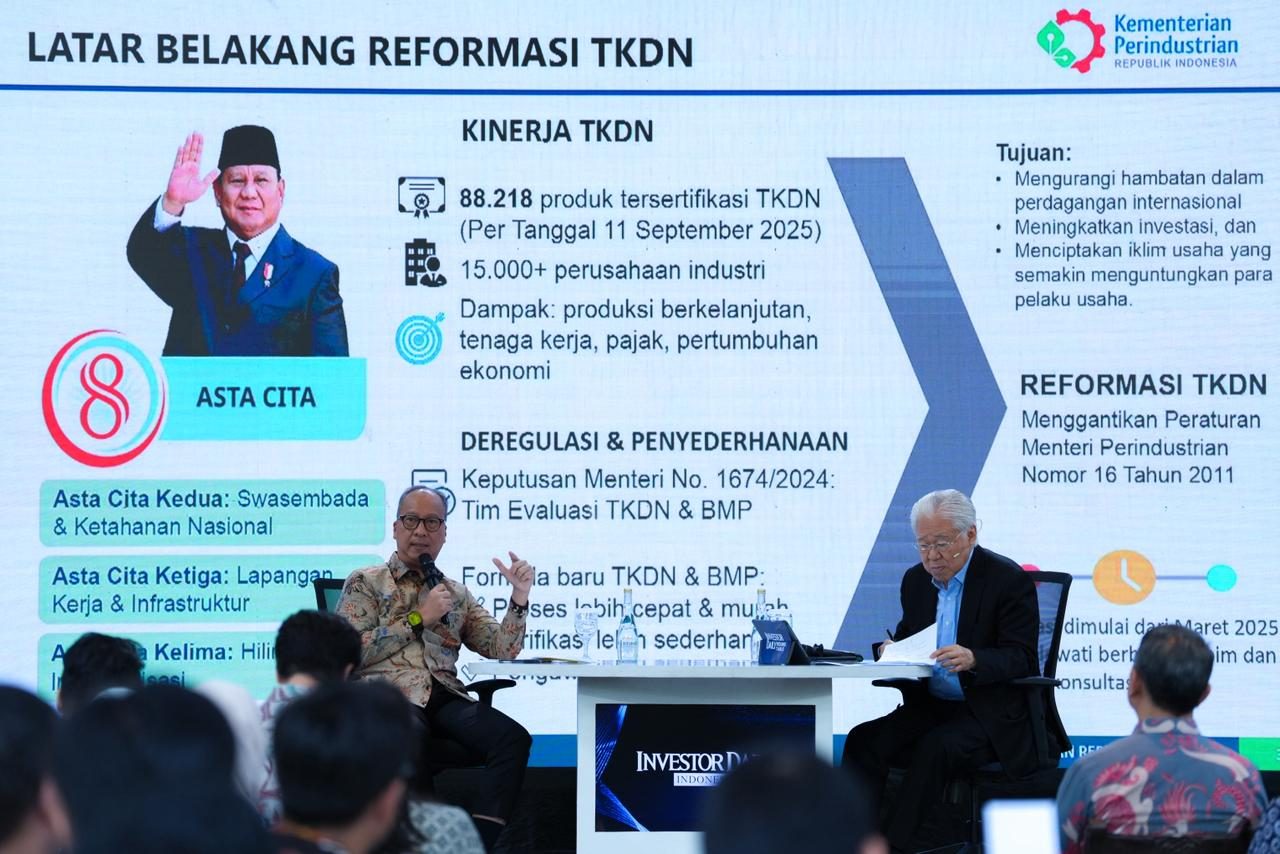
The Ministry of Industry (Kemenperin) has issued Regulation of the Minister of Industry (Permenperin) Number 35 of 2025 on Procedures for Issuing Domestic Component Level (TKDN) Certificates. This new regulation is an important milestone in strengthening the national industrial ecosystem through policies that are cheaper, easier, faster and incentive-based.
Minister of Industry Agus Gumiwang Kartasasmita explained that the issuance of Permenperin 35/2025 is the result of in-depth discussions that began in March 2025, replacing Permenperin Number 16 of 2011, which is more than 14 years old.
“Regulations cannot and must not be considered sacred. When there are new dynamics and needs on the ground, the government must dare to re-regulate. That is why since March 2025 we have kicked off the revision of Permenperin 16/2011,” the Minister of Industry said in Jakarta on Wednesday (15/10).
The Minister of Industry said the TKDN policy applies to all types of industrial products purchased by the government and state/regional-owned enterprises (BUMN/BUMD) through public procurement (PBJ), whether high-tech or not. The main criterion is not whether a product is classed as high-tech or produced by a high-tech industry, but whether domestic industry is capable of producing it.
If high-tech products can already be produced by domestic industry, the government must prioritize buying those products over imports. However, if domestic industry does not yet have the capability to produce them, the government is allowed to purchase similar imported products.
Meanwhile, the application of the TKDN policy to industrial products bought by households and the private sector depends on the policies of other Ministries/Agencies supervising the sector concerned. “So the application of the TKDN policy to high-tech products does not depend on whether an industry is high-tech or not, but on the assessment of other Ministries/Agencies supervising that sector in their efforts to attract investment and develop the sector,” the Minister explained.
Agus also stressed that the revision of the TKDN rules was carried out on the government's own initiative, not because of pressure from other countries. “If we recall, the Trump tariffs only took effect on 1 April 2025, while we had started discussing the revision a month earlier. So it was not because of the Trump tariffs. This shows the nation's collective awareness to strengthen domestic products, not external pressure,” he stressed.
According to the Minister of Industry, Permenperin 35/2025 is also part of aligning with the major national development agenda, including the second, third and fifth points of the Asta Cita: increasing the added value of domestic resources, strengthening industry and expanding employment opportunities.
“Our main goal is simple: every rupiah spent on domestic products, with funds from taxpayers in the state budget (APBN), creates IDR 2 of added value at home. That added value is enjoyed by industrial workers, companies and the state. It is different if APBN funds from taxpayers are spent on imported products, because then the added value is enjoyed by the industries, workers and governments of other countries,” Agus explained.
The Minister of Industry also said the logic of the TKDN policy stems from the principle of fiscal fairness. Because government procurement funds come from the people's taxes, the spending must flow back to industries that create jobs at home.
“We want to protect workers and the national industrial ecosystem. So if there is already a domestic product with a TKDN value above 40 percent, government spending must use that product and must not import,” he said.
Flooding the e-Catalog
The Minister of Industry said that for the mandatory TKDN principle to work effectively, the government's strategy is to flood the LKPP e-catalog with products made in Indonesia.
“Because public procurement is done through the e-catalog, the key is to increase the number of domestic products listed there. So the procedure for calculating TKDN certificates must be made cheaper, easier and faster,” he said.
To date, 88 thousand products from 15 thousand companies have been TKDN-certified and listed in the e-catalog. “We are targeting that number to double within the next two years,” he added.
Besides quantity, Permenperin 35/2025 also emphasizes value-added incentives for industry. “In this new regulation, the calculation procedure is not only fast and efficient, but also contains incentive value that did not exist in the old regulation,” Agus continued.
The Minister of Industry explained that industries that invest and build factories within the Republic of Indonesia automatically receive 25 percent added value. In terms of labor, 10 percent added value is given for using local workers, plus an additional 15 percent from applying the Company Benefit Weight (BMP).
“We have simplified the BMP and made it more inclusive. We have prepared 15 factors that determine BMP, from employing local workers, adding new investment, partnerships and strengthening supply chains to import substitution. Added up, the total weight can reach 38 percent,” Agus explained.
Through this combination of TKDN and BMP, industry players can reach the 40 percent threshold more easily. “This is a concrete example of how we are delivering regulation that is cheap, easy and fast, and that provides real incentives for the business world,” he added.
Protecting investment
The Minister of Industry also cited the success of applying the TKDN policy in certain sectors, such as mobile phones, handheld computers and tablets (HKT) and medical devices.
“We thank the Ministry of Communication and Digital Affairs, which requires a minimum TKDN value of 35 percent for HKT products to obtain a marketing permit. As a result, investment in HKT in Indonesia has increased and imports have fallen,” he said.
The same goes for the Ministry of Health, which now requires medical devices to have a minimum TKDN value of 20–30 percent to be distributed in domestic hospitals. “If other ministries copy policies like this, I am sure our national manufacturing will take off,” Agus said optimistically.
Besides government procurement, Permenperin 35/2025 also encourages consumer goods industries to display TKDN values on their products, even though they are not bound by marketing permit or public procurement obligations.
“We are not making it mandatory, but we are encouraging it. Our hope is that when our children go to the supermarket, they can see, for example, two bottled water products, one without a TKDN label and the other displaying its TKDN value. We want them to choose the one with TKDN. This is part of a big campaign to love Indonesian products,” the Minister of Industry said.
The Minister of Industry reaffirmed that Permenperin 35/2025 is not merely an administrative revision, but a strategic reform. “This regulation was born from a collective awareness that economic self-reliance can only be achieved if public spending and national consumption favor domestic industry. We want TKDN to be not just a number, but a symbol of national pride,” he concluded.
Source: Press Release of the Ministry of Industry of the Republic of Indonesia